



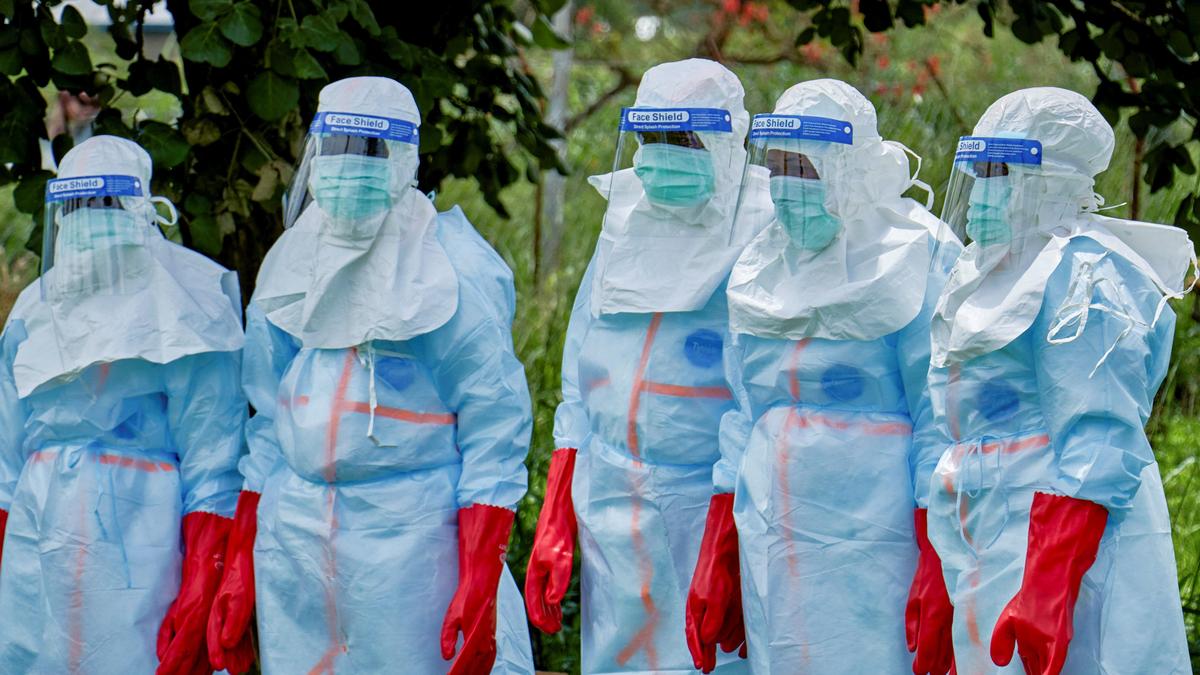
India directs States to tighten Ebola surveillance after WHO PHEIC declaration
India’s health system is being told to step up Ebola readiness after the World Health Organization declared the ongoing Ebola Disease outbreak in the Democratic Republic of Congo and Uganda a Public Health Emergency of International Concern on May 17, 2026, The Hindu reported. The Centre has directed all States and Union Territories to strengthen surveillance, hospital preparedness and rapid response systems. [1]
States have been asked to intensify surveillance under the Integrated Disease Surveillance Programme, with a focus on spotting unusual clusters of fever and symptoms suggestive of Ebola Disease, particularly among individuals with a recent travel history to affected regions. [1]
The Health Ministry has also circulated a Standard Operating Procedure that lays out disease surveillance steps as well as sample collection, storage and referral mechanisms for suspected Ebola cases. [1]
On the preparedness front, States have been instructed to identify designated isolation facilities and dedicated ambulances, with infection prevention and control measures in place. [1]
The move comes amid a fast-moving sequence of developments in mid-May: on May 16, the World Health Organization declared the Ebola outbreak a public health emergency of international concern but not a pandemic emergency, following reports of deaths and spread across the border into Uganda from the Democratic Republic of Congo. [1]
For laboratory testing, the Centre said the Indian Council of Medical Research’s National Institute of Virology in Pune remained fully equipped to test samples for Ebola. [1]
Punya Salila Srivastava cautioned that growing international trade and travel necessitated “adequate preparedness and response capacities at all levels of the health system.” [1]
Timeline· Live
The African public health agency confirms an escalating Ebola outbreak in DR Congo, Uganda, and South Sudan with the death toll surpassing 100, including multiple Americans among the newest cases, prompting the WHO to declare a health emergency of international concern over a rare variant with no approved treatments; amid mounting global alarm, the U.S. intensifies efforts to safely relocate affected Americans, imposes travel bans and enhanced screening protocols, accelerates experimental drug trials, and strengthens cross-border containment measures while Canada refrains from immediate travel bans; the outbreak has severely disrupted daily life and international travel, with incidents including a suspected super-spreader event, cancellation of Congo national football team training, diversion of flights, community unrest marked by the torching of an Ebola treatment center in Ituri, and new travel restrictions between Uganda and DR Congo; former CDC director Robert Redfield warns the Ebola outbreak in Africa could escalate into a very significant pandemic, underscoring the urgent need for intensified global response and containment efforts, and the Africa summit in India has been postponed due to fears surrounding the outbreak.
African health agency confirms Ebola outbreak
The Africa Centres for Disease Control and Prevention and other regional health authorities formally confirmed an Ebola outbreak in the Democratic Republic of Congo, marking the official start of the reported incident.
- Initial reports put death toll at 65 in eastern DRC
Early reporting from the outbreak's epicenter in eastern DR Congo said roughly 65 people had died, indicating a fast‑moving and lethal local outbreak.
Deaths climb and outbreak spreads into Uganda
By the following day the reported death toll had risen (reports cited roughly 80–87 deaths) and infections were reported to have crossed the border into Uganda, signaling regional spread of the outbreak.
WHO warns of 'extraordinary' Ebola strain
The World Health Organization publicly warned that the strain involved and the outbreak dynamics were 'extraordinary,' elevating international concern about transmissibility and severity.
WHO declares global public health emergency
The WHO declared the Ebola outbreak in DR Congo and Uganda an international (global) public health emergency, mobilizing global attention and resources to contain the spread.

Published May 22, 2026
Synthesized from 1 source