



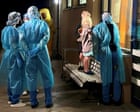
White House pauses removals to DR Congo during Ebola outbreak
The Trump administration is temporarily pausing the removal of refugees to the Democratic Republic of Congo as a spiraling Ebola outbreak continues, The Guardian reported. [1]
Unnamed officials raised concerns that federal immigration agents could come into contact with the Ebola virus during removal trips, and that the virus could spread closer to the U.S. because of the administration’s immigration tactics. [1]
Jeremy Konyndyk argued that the safety rationale cuts both ways, saying: “By the government’s own logic, if it is not safe for people to come from there to here, it is equally unsafe to send people there.” [1]
The move comes amid a fast-moving regional crisis. On May 15, 2026, a new Ebola outbreak was reported to have killed 65 people in eastern Democratic Republic of Congo. [1] By May 17, 2026, the World Health Organization had declared an emergency, and U.S. travel restrictions were described as tightening as the situation escalated. [1]
The temporary pause reflects an internal debate over the risks involved in continuing removals during an outbreak, balancing enforcement operations against worries about potential exposure during travel connected to deportations. [1]
Timeline· Developing
The African public health agency confirms an escalating Ebola outbreak in DR Congo, Uganda, and South Sudan with the death toll surpassing 100, including multiple Americans among the newest cases; Uganda now reports five total cases after confirming three new infections including a health worker, prompting the WHO to declare a health emergency of international concern over a rare variant with no approved treatments and raise the risk level in DR Congo to 'very high'; amid mounting global alarm, the U.S. intensifies efforts to safely relocate affected Americans, imposes tighter travel bans and enhanced screening protocols, reroutes U.S. passengers flying from Ebola-affected countries, accelerates experimental drug trials, strengthens cross-border containment measures, designates Bush Airport in Houston and names a second U.S. airport for Ebola screening as entry points for travelers from Africa; meanwhile, Canada refrains from immediate travel bans; the outbreak severely disrupts daily life and international travel with incidents including a suspected super-spreader event, cancellation of Congo national football team training, diversion of flights, community unrest marked by the torching of an Ebola treatment center in Ituri by a mob denying the existence of Ebola, and new travel restrictions between Uganda and DR Congo; escalating community resistance complicates containment efforts, leading Congo to curtail funeral wakes to reduce transmission risks as WHO upgrades the overall risk assessment; former CDC director Robert Redfield warns the outbreak could escalate into a significant pandemic, underscoring the urgent need for intensified global response, while the Africa summit in India has been postponed due to fears surrounding the outbreak; most recently, the Red Cross reports the deaths of three volunteers from Ebola in DR Congo, highlighting the severe risks faced by frontline responders, the U.S. further tightens Ebola travel restrictions as new cases emerge abroad, the White House pauses removal of detainees to the DRC as the outbreak widens, and the US CDC expands Ebola screening to a second airport amid the outbreak.
African health agency confirms Ebola outbreak
The Africa Centres for Disease Control and Prevention and other regional health authorities formally confirmed an Ebola outbreak in the Democratic Republic of Congo, marking the official start of the reported incident.
- Initial reports put death toll at 65 in eastern DRC
Early reporting from the outbreak's epicenter in eastern DR Congo said roughly 65 people had died, indicating a fast‑moving and lethal local outbreak.
Deaths climb and outbreak spreads into Uganda
By the following day the reported death toll had risen (reports cited roughly 80–87 deaths) and infections were reported to have crossed the border into Uganda, signaling regional spread of the outbreak.
WHO warns of 'extraordinary' Ebola strain
The World Health Organization publicly warned that the strain involved and the outbreak dynamics were 'extraordinary,' elevating international concern about transmissibility and severity.
WHO declares global public health emergency
The WHO declared the Ebola outbreak in DR Congo and Uganda an international (global) public health emergency, mobilizing global attention and resources to contain the spread.

Published May 23, 2026
Synthesized from 2 sources